
Dog-Friendly 14ers: Which Peaks Allow Dogs and Which to Skip
Most Colorado 14ers sit on National Forest land and allow dogs. That is the easy part. The harder questions are whether a given route is a dog route at all, what the leash rule is once you cross a wilderness boundary, and whether your dog is ready for a day that starts at 11,000 feet and goes up. Here is what the land managers say, peak by peak, and the cautions that apply to all of them.
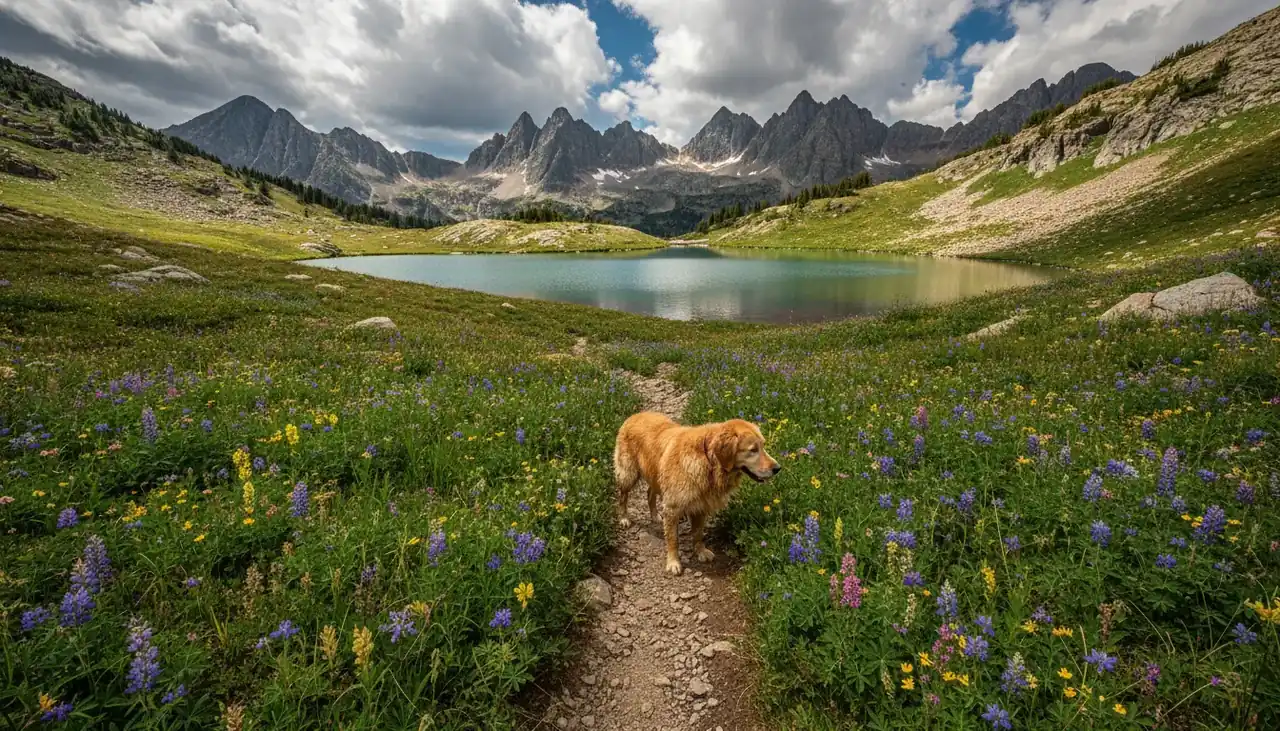
AI illustration of alpine terrain, not a specific peak.
The peaks, sorted by what the rules say
| Peak | Dogs | Leash rule | Notes from the managing agency |
|---|---|---|---|
| Quandary Peak | Allowed | Summit County immediate control or leash; outside the Eagles Nest Wilderness leash order | Class 1; 3.1 miles and 3,344 feet each way. Talus on the east ridge is hard on pads. Resident mountain goats. Summer parking reservation ($10–$55) or $7 Breckenridge shuttle mid-June to mid-September; dogs ride free. |
| Grays and Torreys | Allowed | Hand-held leash required (Forest Service) | About 4 miles and 3,000 feet to Grays. Stevens Gulch road is rough; plan on 4WD. |
| Mount Bierstadt | Allowed | Leashed at all times (Mount Evans Wilderness) | 3.6 miles and about 2,600 feet. Willows and a Scott Gomer Creek crossing low on the route. Trail closed April 1–June 15 for mud season. Do not take a dog onto the Sawtooth. |
| Mount Blue Sky (Evans) | Allowed | Hand-held leash everywhere in the recreation area and wilderness | Timed-entry ticket to drive the road. Pets may not be left in vehicles. |
| Pikes Peak via Barr Trail | Allowed | Leash expected; Colorado Springs city code applies at the bottom | 12 miles and 7,400 feet one way. Not recommended for most dogs. No dogs in the Summit Visitor Center or on the summit shuttle. |
| Mount Elbert | Allowed | No specific leash order found on the Forest Service page | Trailhead has restrooms and no fee. |
| Longs Peak | No dogs | Rocky Mountain National Park | Pets are prohibited on all park trails, tundra and meadows. |
| Culebra Peak | No dogs | Private ranch | Reported by climbers rather than an agency page; treat it as a no. |
Any peak with a Class 3 or harder route, including the Sawtooth traverse, Capitol, Little Bear, the Crestones and the Maroon Bells, is not a dog route. The Colorado Fourteeners Initiative and 14ers.com both ask that dogs be leashed around mountain goats and bighorn sheep on every peak.
Quandary Peak, the one most people start with
Quandary's East Ridge is the standard first 14er for dogs because it is a walk-up with no scrambling. Three things trip people up. First, access: from mid-June to mid-September (June 13 or 14 through September 13 or 14 in 2026) you need a paid parking reservation or the Breckenridge shuttle, and parking on McCullough Gulch Road, Blue Lakes Road or Highway 9 earns a $100 ticket. Second, water: there is none on the route, so plan on carrying at least two liters for the dog alone. Third, footing: the upper east ridge is loose talus that chews through pads. Boots or at least a pad check every half hour above treeline.
Quandary is outside the Eagles Nest Wilderness, so the Forest Service page does not state a leash rule and Summit County's standard applies: the dog must be under immediate control or on a leash. Above treeline, with goats around, that means a leash in practice. If you want altitude without the summit day, McCullough Gulch next door has waterfalls, a lake and actual water for the dog, and shares the same shuttle system.
Grays, Torreys and Bierstadt: leash required, no exceptions
The two most popular Front Range 14er trailheads sit on land where the Forest Service posts a hand-held leash requirement. On Grays Peak Trail the page says so outright. Mount Bierstadt lies inside the Mount Evans Wilderness, where the leash rule covers everything including the summit. Expect to be told if your dog is loose. Bierstadt's lower route crosses willows and Scott Gomer Creek, which is cold and fast in early summer and the main reason to time the hike for July or later; the trail is closed anyway from April 1 to June 15.
Altitude is the real test. The Forest Service pages for Grays and Quandary both say that none of the Fourteeners are easy hikes because of the elevation, and they stress starting early to be off the summit before afternoon lightning. Front Range veterinarians list these warning signs on high trails: shortness of breath, excessive panting, drooling, pale gums, lethargy, nosebleed, vomiting and collapse. If you see them, turn around and descend. For anything beyond that, ask your vet; this page is not medical advice.
Before you commit to a summit day
- Build up first. Trails above 11,000 feet such as Lily Pad Lake (leash under six feet, Eagles Nest Wilderness) or McCullough Gulch tell you how your dog handles thin air without a 3,000-foot commitment.
- Carry water and a bowl. Quandary, Grays and Bierstadt all have long dry stretches above treeline.
- Protect the feet. Talus and sun-heated rock are the usual reasons a dog ends up being carried down. Check pads at every break.
- Start before dawn. Summer storms build by early afternoon; a dog does not move faster when it is tired and scared of thunder.
- Keep the dog off goats and sheep. Harassing wildlife is a citation on every one of these peaks, and a goat will stand its ground.
- Know when to leave the dog home. Flat-faced breeds, seniors and dogs that have never been above 10,000 feet are poor candidates for a first 14er. A day of boarding in Denver or daycare is cheaper than a rescue.
Where to base yourself
Quandary and McCullough Gulch are twenty minutes from Breckenridge, where dog-friendly lodging is common and the town shuttle takes dogs. Our Breckenridge and Summit County hub covers the leash rules in town, and the Sapphire Point loop above Dillon Reservoir is a sensible recovery walk the day after. Grays and Bierstadt are day trips from Denver, Golden and Evergreen.