
Dispersed Camping With Dogs: Forest Service and BLM Rules, Wildlife and Water
Dispersed camping on National Forest and BLM land is the most dog-friendly way to sleep outside in Colorado: no campground host, no pet fee, usually no leash requirement at the site. It is also the setting where the rules are least posted and the consequences of a loose dog are highest, between moose, elk, goats, cattle and other campers. Here is what the agencies actually require, where the leash comes back, and how to handle fire, water and wildlife with a dog in camp.
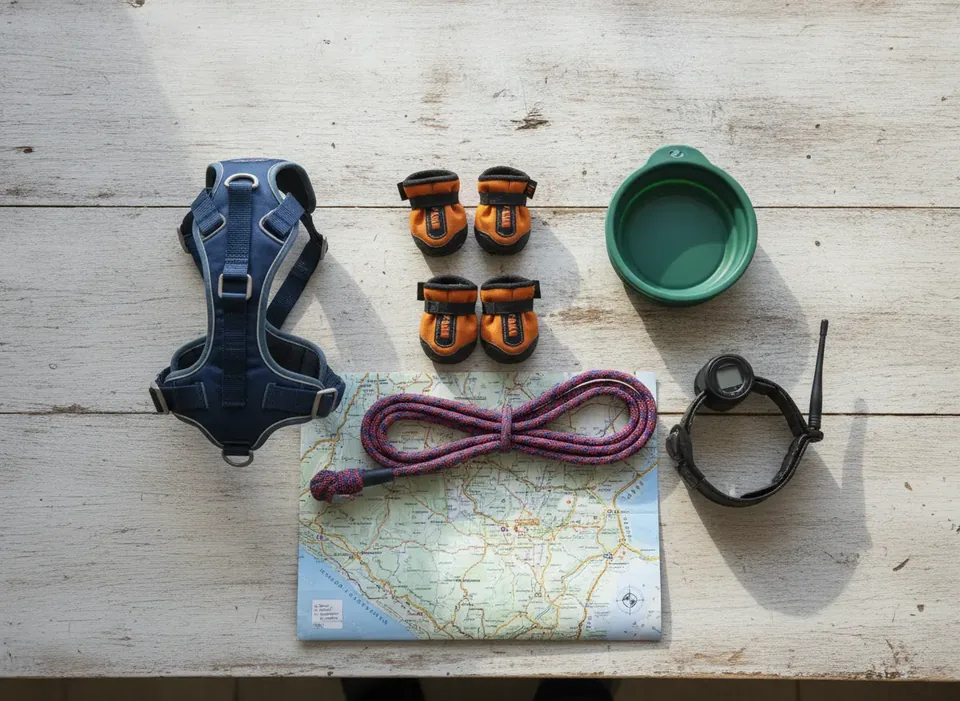
AI illustration of a backcountry camp, not a specific site.
The rules by land type
| Where you are | Dog rule | Source of the rule |
|---|---|---|
| General National Forest (dispersed sites, non-wilderness) | No forest-wide leash law. The site page or ranger district order governs; where it is silent, the county standard applies (Summit County: immediate control or leash). | Individual fs.usda.gov recreation pages |
| Developed Forest Service campgrounds and picnic sites | Crated, caged or on a leash no longer than six feet. | 36 CFR 261.16(j) |
| Eagles Nest Wilderness (Summit and Eagle counties) | Leash less than six feet on all trails and NFS lands within the wilderness. | White River NF forest order |
| Mount Evans Wilderness and Mount Blue Sky area | Hand-held leash everywhere; pets may not be left in vehicles at Summit Lake. | Arapaho-Roosevelt NF |
| Indian Peaks and James Peak Wilderness | Hand-held leash (six feet or shorter per the wilderness alliance); hunting dogs exempt while legally hunting. | Order 10-00-07, 36 CFR 261.58(s) |
| Maroon Bells-Snowmass Wilderness | Dogs leashed; no dogs in the Conundrum Hot Springs permit zone or on the Maroon Lake Scenic Loop. | White River NF |
| San Juan National Forest around Durango | Voice control allowed on the federal lands surrounding town, per the City of Durango's summary. Junction Creek and Spud Lake pages state no leash rule. | durangoco.gov; fs.usda.gov |
| BLM near Durango | Animas City Mountain and Grandview Ridge closed Dec. 1–April 15 for wintering deer and elk. | BLM Tres Rios |
| State parks and Rocky Mountain National Park | Six-foot leash in parks; RMNP bans pets from all trails, tundra and meadows. | CPW; NPS |
The pattern: the farther you get from a trailhead on non-wilderness forest, the fewer posted rules there are, but the moment you cross a wilderness boundary the leash is mandatory and enforced. Trails we cover inside those orders include Lily Pad Lake in the Eagles Nest Wilderness; trails outside them include McCullough Gulch, Quandary Peak and the Junction Creek section of the Colorado Trail.
Fire restrictions
Fire bans are set by county, forest and ranger district and change week to week in a dry summer. Before any dispersed trip, check the current restriction stage for the exact ranger district you are camping in, not just the forest; a stove may be allowed where a campfire is not. With a dog in camp the fire ring is also a burn hazard for a tired animal that lies down too close, and in a ban the stove goes where the dog cannot knock it over. Pack out ash-covered food scraps; a dog will dig them up after you leave.
Water
Most Colorado foothills and ridge trails have no water, and above treeline the only water is snowmelt that disappears by August. Our trail records note where it exists: McCullough Creek and its lake, Junction Creek for the first two miles of the Colorado Trail, Lily Pad Lake and its ponds, the Animas River. Everywhere else, plan on carrying water for the dog, roughly as much as for yourself on a hot day, and on filtering or treating what you draw for yourselves. Keep the dog out of small alpine lakes that other campers draw from, and camp and wash well back from any water source.
Wildlife is the real reason for the leash. The Forest Service page for Lily Pad Lake warns that dogs can provoke moose. Mountain goats hold the ridges on Quandary and Grays and do not back down. Elk herds move through Evergreen's Elk Meadow and the rut runs September to October. Bears are why Boulder puts a leash rule on its foothills trails from August 15 to December 1. Rattlesnakes are on every Front Range foothills trail from April to October. A dog that chases any of them is a citation for harassing wildlife ($300 in Jefferson County) and, with moose and goats, a vet visit or worse. In camp, food, trash and dog food go into a bear canister or the car, never the tent.
Camp habits that keep dispersed sites open
- Tie out at camp. Even where voice control is legal, a long line at the site keeps the dog out of the next camp and off the road at 2 a.m.
- Pack out waste. Bag it and carry it, or bury it like your own well away from water. Boulder, Larimer and Jefferson counties all treat a bagged pile left for later as a violation; the forest is no different in spirit.
- Never leave the dog unattended at a site or in a vehicle. Developed campgrounds state this outright; it is the single most common reason a Forest Service host asks a camper to leave.
- Check pads and coat nightly. Foxtails and cheatgrass awns, roughly June through October, burrow into paws, ears and armpits; a full-body check at camp catches them before they migrate. Anything swollen or painful the next morning is a vet visit.
- Keep ID current. A tag with a phone that works without cell service (a friend in town) and a microchip. A GPS collar helps only if you bring the battery to use it.
When a campground is the better call
A first trip, a young dog, a heat wave or an active fire ban all argue for a developed campground with water and a host. Around Durango, the San Juan National Forest campgrounds at Junction Creek, Haviland Lake, Transfer Park and Miller Creek all publish the same rule: dogs leashed or otherwise physically restrained and never left unattended. Around Dillon Reservoir, Heaton Bay, Peak One, Pine Cove, Prospector and Lowry do not publish a pet rule, so confirm on recreation.gov. State park campgrounds (Golden Gate Canyon, Staunton, Cheyenne Mountain, Mancos) run on CPW's six-foot leash. Browse the full campground directory, Summit County campgrounds and Evergreen-area campgrounds. A dog whose recall is not yet reliable around wildlife is a candidate for a few outdoor sessions with a Denver trainer or Boulder trainer before the first wilderness trip, and for boarding if the trip is a Class 3 scramble it cannot join.